

Hey email app is finally on iPhone App Store: What went wrong
Hey email app is finally on iPhone App Store: What went wrong
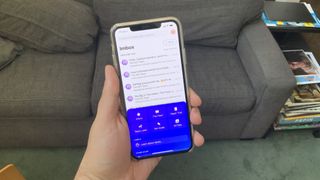
The Hey electronic mail app and service went from curious alternative to Gmail to talk of the app programmer town in a affair of days. And it's as well shined light on some contentious debates betwixt Apple and the developers who create apps for its platforms.
Developed by the folks behind Basecamp, a projection management and team communication app that predates Slack and all of the copy-Slacks, Hey declared war on the idea that everyone should be allowed piece of cake entry into your inbox. Yes, communication is practiced, just does every single brand and marketing house on earth deserve instant access to you?
- What are the best email services?
- Everything you need to know about the iPhone 12
- Our guide to the best email apps
When I kickoff heard about the Hey email app, on the Rocket podcast where Basecamp founder David Heinemeier Hansson revealed that motive behind the app, I knew I wanted to test it out.
In curt, Hey divides the email feel between The Imbox —yes it's called that because information technology's where your Important emails are — The Feed (newsletters and stuff you lot might intendance about) and The Paper Trail, (the identify yous keep all the damn receipts you lot get online).
Oh, and at that place's also The Screener. That's where you lot get to block or accept email by sender. That way, you get to be the bouncer and go on no-good emailers away for good. That might sound similar piece of work for some, or it might sound like the ultimate manner to make clean up for others.
Unfortunately for Hansson and and anyone who enjoys that arroyo to email, the Hey email app striking the headlines this month for all the wrong reasons.
Hey email app: Rejected updates
One solar day subsequently Hey launched, Apple reportedly flexed its musculus as the owner of the iOS App Shop. While Apple didn't announce things publicly, Hansson jumped to Twitter to reveal the behind-the-scenes story, saying Apple had rejected app updates that would fix bugs and add new features.
Of course, Hansson says, if his company were to hand over a substantial cut of its revenue, Hey would be allowed to stay. This was all very bad timing for Apple, as the Eastward.U. European Commission opened its investigations into the App Store rules on that same day (June 16). It also happened to exist less than a week before Apple's annual developer conference, potentially causing a source of friction at the event.
Wow. I'm literally stunned. Apple tree simply doubled downward on their rejection of HEY's ability to provide bug fixes and new features, unless we submit to their outrageous need of 15-30% of our revenue. Even worse: We're told that unless we comply, they'll REMOVE THE APP.June 16, 2020
The fifteen-30% Hansson references is the cut Apple typically takes from in-app purchases. Often times apps accuse more on the App Store to make upwardly for this cut. YouTube Tv set, for example is $49.99 per month if you buy it directly, just $54.99 per calendar month if you subscribe through an Apple tree app.
Apple stuck to its guns when its Phil Schiller, senior vice president of worldwide marketing, told Tech Crunch that Apple'south issue stems from the experience that a user would have upon downloading the app. Because Hey would sell it subscriptions outside of the app to avoid Apple'southward tithe, Schiller said, "you download the app and information technology doesn't piece of work, that'due south not what we want on the store." On Rocket, Hansson explained that Basecamp is a relatively minor arrangement and didn't take the wherewithal to surrender such a cutting.
When y'all downloaded Hey, at kickoff, you were prompted to log in with your business relationship credentials. Those who didn't have a username and countersign would just have to effigy out how to get a subscription. This is because Apple tree'south rules say you're not allowed to market place the culling ways to pay for the service.
As the Apple-Hey feud hit the news, folks brought upwards Netflix and Spotify, and other apps that require y'all to go outside of the app to become an account to arrive piece of work. Those apps, which are categorized as "reader" apps (ostensibly because their features are limited to the consumption of content) were the exception, in Apple's heed. Email apps could not fall under this category.
The ire from the programmer customs surrounding Apple pushing Hey to fold to its ways was visible to anyone watching the more than vocal members, with Adventitious Tech Podcast co-hosts John Siracusa and Marco Arment beingness two of the biggest names lamenting Apple'southward rules. Arment referred to Apple tree as "incredibly power-hungry and shockingly stingy," when discussing Hey.
The fight came to a pause hours before Apple'south big keynote that kicks off its Worldwide Developers Conference (WWDC 2020), as Apple allowed an update to the app, which came with a temporary Hey account that's a randomized address. That allows the app to be functional simply from being downloaded from the app store. Hey'south creators also threw in an enterprise version of Hey, dubbed Hey for Piece of work, that made the app more than like Basecamp. You still don't pay for Hey through the app.
Hey tin can be downloaded from the App Store.
Hey email app: Pricing
The Hey email app costs $99 per year. You lot might find that expensive, but Hey says that costless e-mail services, such as Gmail are not actually gratis: "you pay by giving up your privacy and valuable personal data." Hey provides a 14-24-hour interval free trial so you don't demand to commit and so much money up front end.
Hey's privacy-beginning approach doesn't terminate at that place, as it stops "spy pixels" from tracking your activity. Hey offers even more than pricey options, for super-short two-character ($999 per twelvemonth) and iii-graphic symbol ($349 per year) email addresses, such equally hi@hey.com and hey@hey.com.
Hey email app: Reviews
Even though the Hey email app is nonetheless relatively young (less than a month erstwhile) reviews are already out. Those reviews recommended using the trial period before investing the $99 annual fee. Here are summaries of 2 reviews that we found online:
- Kaya Thomas at OneZero wrote "I believe Hey is going to relieve me a lot of fourth dimension and frustration, and so for me the annual fee of $99 is worth it, and it's more affordable (and safer) than Superhuman, the popular email client that's been in individual beta for six years at $30/month."
- Harry Guinness at ReviewGeek wrote "Personally, I'thousand a large fan of how Hey handles things. It works very well for me. Merely I'm hard-pressed to recommend it for the vast majority of people."
Want to endeavor Hey for yourself? You lot can sign up for its fourteen-day free trial here.

Source: https://www.tomsguide.com/news/hey-email-app
Posted by: chavezcongthed.blogspot.com
0 Response to "Hey email app is finally on iPhone App Store: What went wrong"
Post a Comment